Investing In Small Multifamily Properties In Dartmouth
May 28, 2026
May 28, 2026
If you are thinking about buying a small multifamily property in Dartmouth, the first thing to know is simple: this is not a market where duplexes and triplexes are everywhere. That can make the opportunity feel exciting and frustrating at the same time, especially if you want rental income to help offset ownership costs or build a long-term investment. The good news is that Dartmouth does offer a real case for small multifamily investing, but it rewards careful, local due diligence far more than a generic out-of-town playbook. Let’s dive in.
Dartmouth is a mostly owner-occupied market, which shapes how small multifamily investing works here. The town has an estimated 34,367 residents, 12,200 households, and a 76.0% owner-occupied housing rate, which is notably higher than the Massachusetts average of 62.5%.
That matters because owner-heavy markets often have fewer income-producing properties available in the first place. In Dartmouth, that supply constraint is especially clear because 82.12% of housing units are single-family homes, while only 8.19% are in 2-to-4-unit structures.
For investors, that means small multifamily is a relatively scarce asset class locally. You are often not just competing on price. You are competing for a property type that does not make up much of the town’s housing stock.
In practical terms, Dartmouth is not a market where you can expect a steady stream of duplexes, triplexes, and small apartment buildings. Most of the housing stock is geared toward single-family ownership, and zoning rules add another layer of constraint.
That scarcity can support the long-term appeal of well-located small multifamily properties. It also means that when one comes to market, you need to evaluate it with discipline rather than assuming the income story will automatically work.
A second point to keep in mind is renter need. Dartmouth’s median gross rent is $1,462, and about 50.45% of renter households are cost-burdened. While that does not guarantee performance for any one property, it does help explain why smaller rental units can remain relevant even in a town with a strong ownership base.
One of the biggest mistakes investors make is treating all multifamily the same. In Dartmouth, the zoning code draws important distinctions between two-family dwellings, three-family dwellings, and multifamily dwellings with four or more units.
That means a duplex is not just a smaller version of a larger apartment building. It is often a different use category entirely, with its own zoning path, lot requirements, and practical investment profile.
For most buyers focused on Dartmouth, the cleanest small multifamily conversation starts with duplexes. Triplexes are a step more restrictive, and four-plus-unit buildings usually belong in a different investment category.
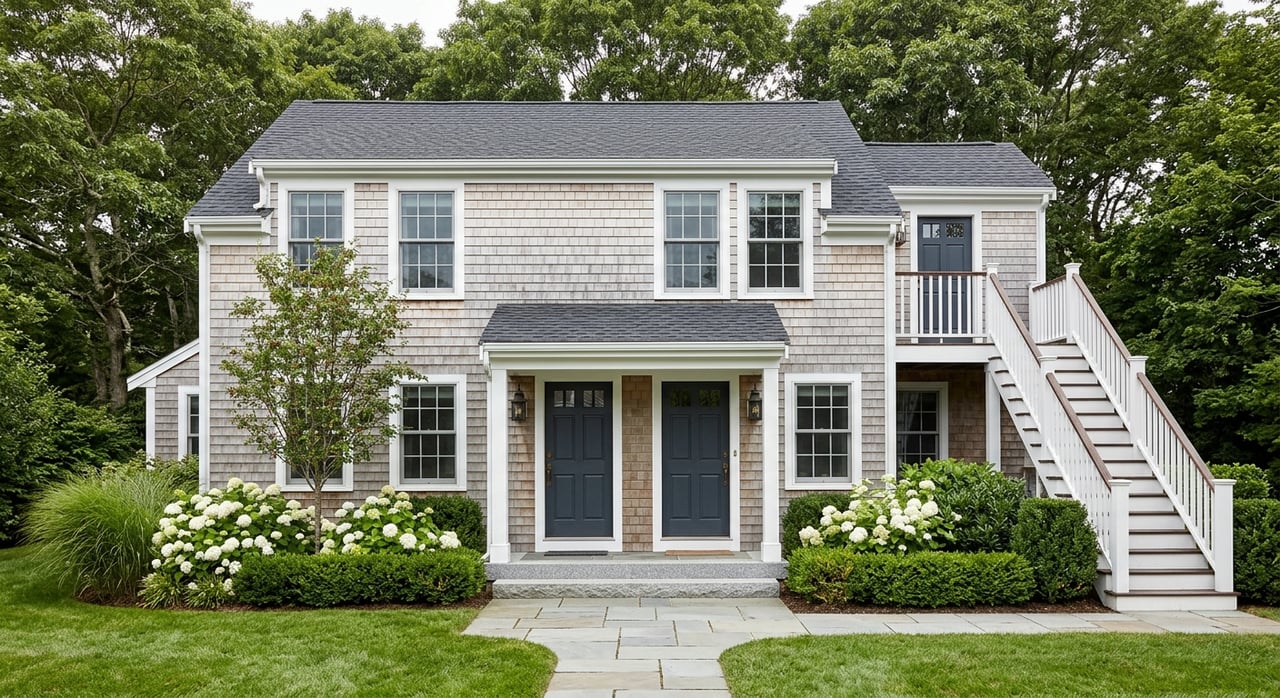
If you want the most realistic entry point into small multifamily investing in Dartmouth, duplexes usually make the most sense. The local use table shows that two-family dwellings are allowed in selected districts, while three-family dwellings are more restricted and four-plus-unit multifamily is limited to a smaller set of districts or permit paths.
In plain language, Dartmouth is more duplex-friendly than triplex-friendly. That does not make every duplex easy to buy or create, but it does make the duplex the most natural target for a local investor or house hacker.
This is especially relevant if your goal is to live in one unit and rent the other. In a market with limited 2-to-4-unit inventory, that strategy can be one of the more practical ways to enter the market while building long-term equity.
In Dartmouth, zoning is not background noise. It is one of the main reasons small multifamily supply stays limited.
For example, in General Residence districts, a two-family lot needs at least 20,000 square feet of lot area and 150 feet of frontage. In Limited Business and General Business districts, a two-family dwelling needs 10,000 square feet per unit.
Those standards can narrow the pool of parcels and existing homes that truly work as legal two-family properties. They also help explain why new small multifamily opportunities are not easy to create, even when demand exists.
Common driveway rules can matter too, especially on infill lots or properties that may have been converted over time. Dartmouth allows common driveways serving up to four residential units, with stricter treatment above that, so site design and access can affect what is feasible.
Because true duplex inventory is limited, many buyers need to think creatively. If you are drawn to the idea of rental income but cannot find a small multifamily property that checks the boxes, an accessory dwelling unit may be worth exploring.
Dartmouth’s use table shows accessory dwelling units are permitted in the single-residence districts. For some homeowners, that creates an alternative path to house hacking without needing to purchase a traditional duplex.
This option is not the same as owning a two-family property, and you still need to confirm local rules, permits, and physical feasibility. Still, in a town where small multifamily supply is tight, it can be a useful strategy to keep on your radar.
A small multifamily investment only works if there is reliable rental demand behind it. In Dartmouth, one of the clearest demand drivers is UMass Dartmouth.
The university reports 7,968 total enrolled students, with 2,909 living on campus. That leaves a meaningful population of students who may look off campus, while faculty and staff can also support long-term rental demand in the surrounding area.
Transportation adds another layer. SRTA serves Dartmouth directly along with New Bedford and Fall River, and South Coast Rail service to New Bedford and Fall River launched on March 24, 2025.
That broader transit network can support demand for smaller, commuter-oriented rental units. It does not mean every property will perform the same way, but it does widen the potential renter pool beyond one immediate neighborhood.
The income story for a small multifamily property in Dartmouth can be appealing, but you need to model it carefully. Using the town’s median gross rent of $1,462, two rented units would generate about $35,088 per year in gross rent before vacancy and operating expenses.
That number can be a helpful starting point, but it is only a starting point. Once you account for taxes, insurance, repairs, maintenance, financing, and turnover, your margin may be much thinner than a quick online calculator suggests.
Property taxes are an important local line item. Dartmouth’s FY2025 residential tax rates range from $8.61 to $9.22 per $1,000 of assessed value depending on the fire district, so a property assessed at $600,000 would carry roughly $5,166 to $5,532 per year in residential property tax before mortgage, insurance, or maintenance.
If you are planning a house-hack, the key question is not just whether rent covers a piece of the payment. It is whether the rent offsets enough of your carrying costs to make the strategy sustainable when normal ownership expenses show up.
This is one of the most important steps in Dartmouth. If you are buying an older duplex, a converted home, or a property that has changed over time, do not assume the current unit count is fully legal just because it exists today.
The Dartmouth Building Department states that permits run through Inspectional Services and that a Certificate of Completion or Occupancy can be issued after inspections are finished. Before you rely on projected rental income, verify whether the property’s unit count is legally conforming or legally nonconforming.
That question can affect financing, insurance, renovation plans, and resale value. It can also shape whether a property is truly an investment opportunity or a much more complicated project than it first appears.
The most grounded way to think about small multifamily investing in Dartmouth is as a selective, long-term strategy. Supply is limited by housing mix, zoning, and site standards, so success often starts with buying the right property rather than trying to force a weak fit.
For many buyers, that means focusing first on duplexes. They align more naturally with Dartmouth’s zoning structure, they can suit owner-occupants well, and they offer a clearer path than triplexes or larger buildings in many cases.
Just as important, you need to stay local in your analysis. In Dartmouth, supply constraints are a big part of the story, not just interest rates or financing terms. A property can look attractive on paper, but the real opportunity comes from understanding zoning, legal use, lot characteristics, access, and local demand together.
If you are exploring a duplex, a house-hack setup, or a broader investment property search in Dartmouth, a process-driven, local review can save you time and help you avoid expensive surprises. To talk through your options with a data-informed local advisor, schedule a consultation with Erin Hovan.
Our team takes great pride in helping clients reach their real estate goals, consistently earning five-star reviews for our dedication and expertise. We serve as trusted advisors to individuals, families, and developers seeking the area’s most desirable properties.